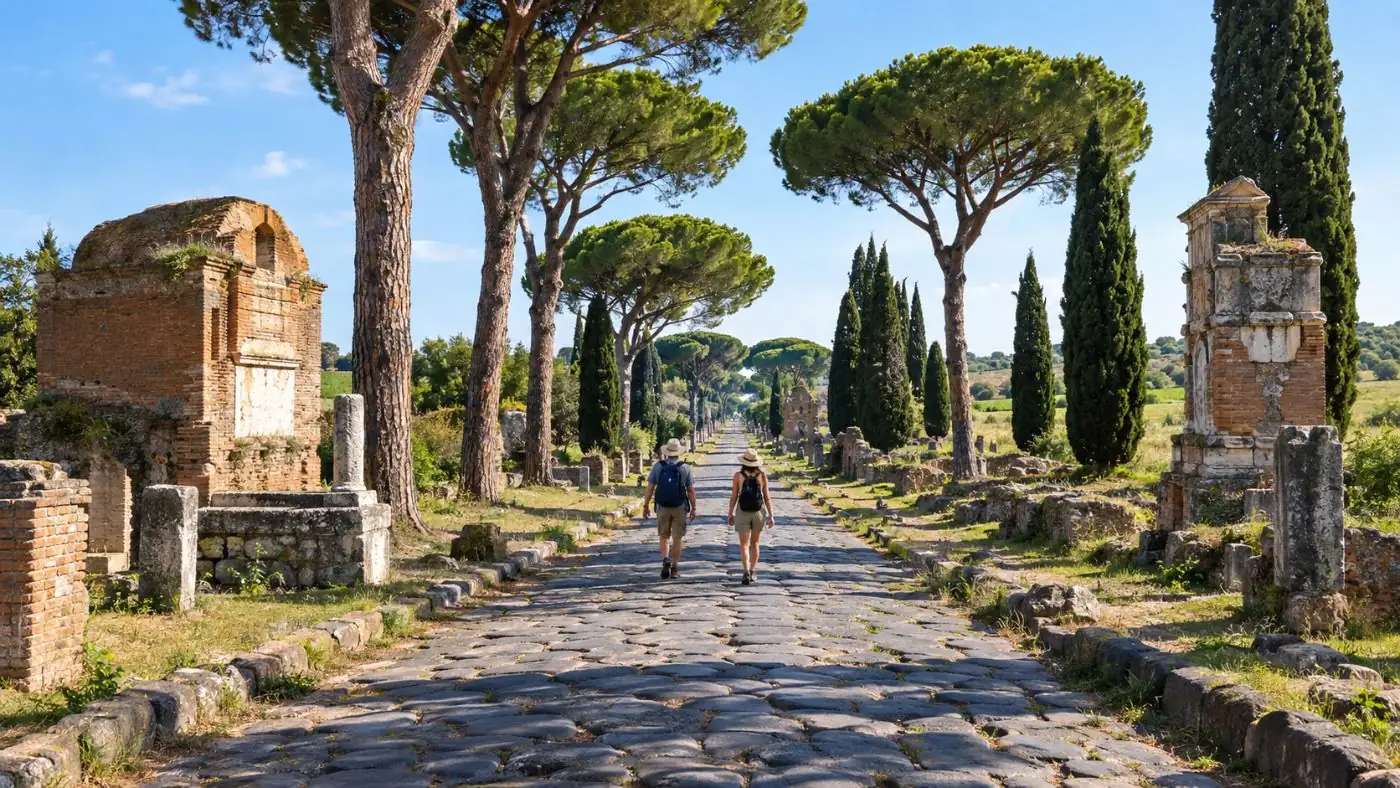
Our booking tip: The 17 km guided trek along the Appian Way, with free cancellation up to 24 hours before. Book this Compare options
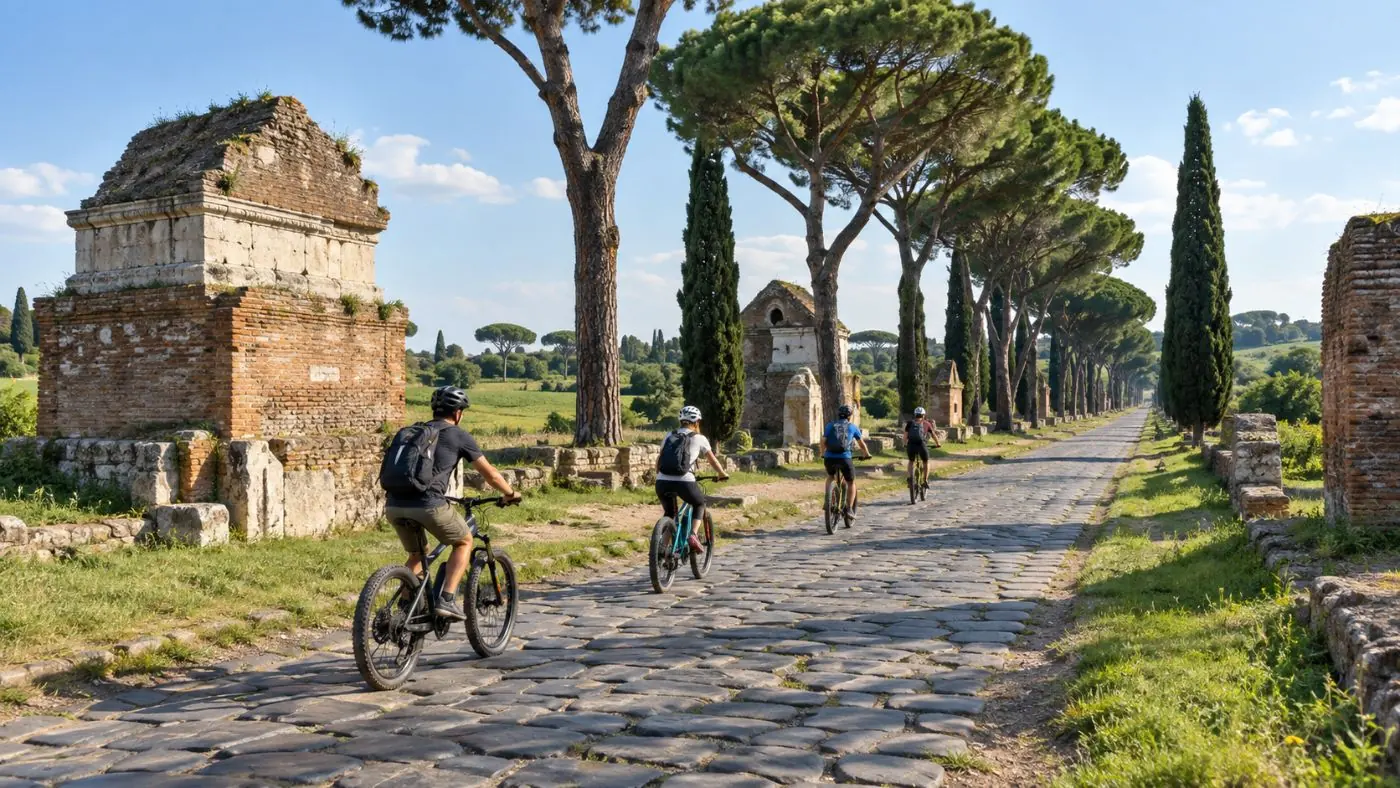
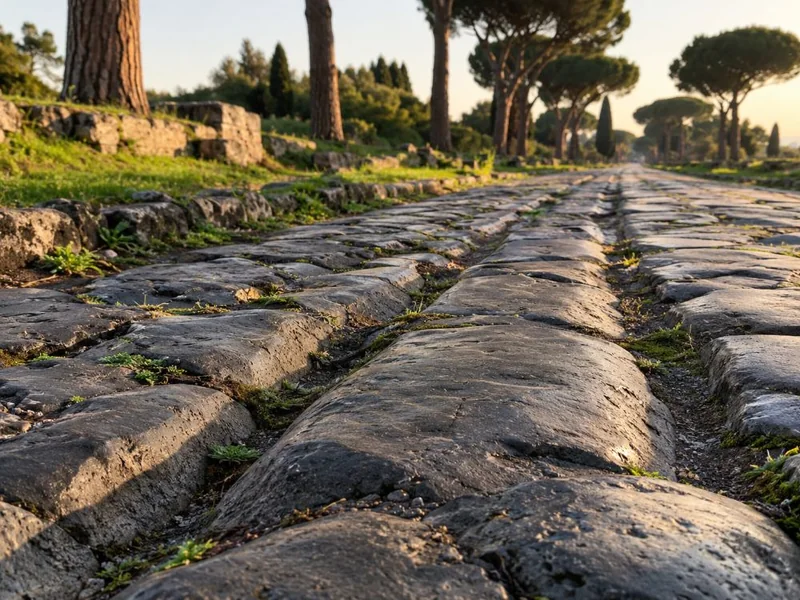
The Appian Way is one of the most beautiful walks in Rome, but it is not a road to tackle spontaneously in flip-flops. The surface changes a lot: asphalt and cars in the first stretch, then the Roman basalt paving stones, large irregular basalt stones with grooves left by the wheels of carts.
The road and the open stretches can be walked freely; only some monuments and catacombs require payment. Below we explain how to divide the route, how much time to allow and when it is worth relying on a guided tour.
The short answer
Yes, you can walk along the Appian Way for free, starting from Porta San Sebastiano. In Rome, you can walk on a well-preserved stretch of about 10 km; a classic walk is about 9 km and takes 4-6 hours including stops. The most evocative section is south of the Mausoleum of Cecilia Metella, where the Roman basalt paving stones reappear and there are few cars. For the return trip, you can take buses 118 and 660.
Can you walk on the Appian Way?
Yes. The road and the open sections of the Park can be walked freely and without a ticket; you only pay for certain monuments, such as Cecilia Metella or Villa dei Quintili, and the catacombs.
There is no single entrance or opening time for the road: the Appian Way is a public street that crosses the Appian Way Archaeological Park, from the Aurelian Walls all the way to Frattocchie, in the municipality of Marino. You can walk for an hour or a whole day, enter the paid sites that interest you and skip the others.
However, keep in mind that the Appian Way is not a continuous pedestrian area. Cars are allowed on part of the road, especially at the beginning, while many sections further south are effectively reserved for pedestrians and bicycles. The pedestrianisation project between Porta San Sebastiano and Via Appia Pignatelli is still in the tender phase, so for now the first stretch must be walked with caution.
Where does the Appian Way start in Rome?
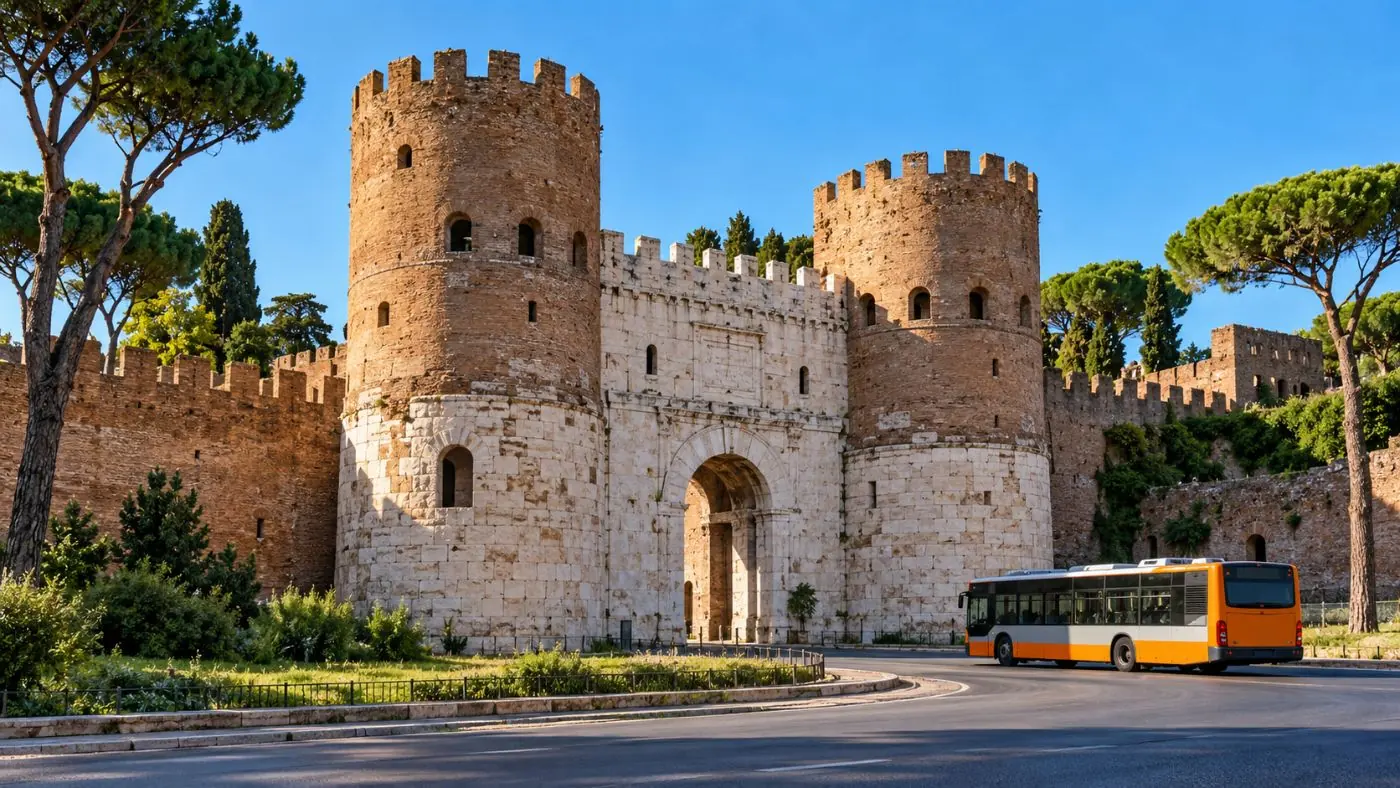
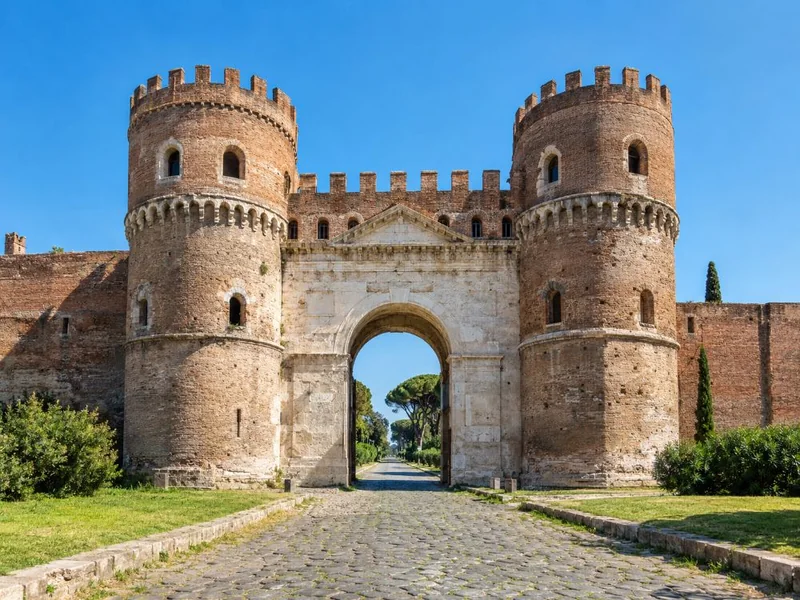
At Porta San Sebastiano, the ancient Porta Appia of the Aurelian Walls. Inside the gate is the Museum of the Walls.
The gate is the natural starting point: here the Appian Way exits the ancient city and begins its route south. Soon after you’ll find the Domine Quo Vadis church, at the junction with Via Ardeatina, and just beyond the area of the San Callisto and San Sebastiano catacombs. How to get there by public transport is explained in our guide on how to reach the Appian Way.
If you prefer to skip the busy stretch, you can start your walk further south, for example at the Mausoleum of Cecilia Metella, reachable by bus 660 from metro A Colli Albani.
How long does it take to walk the Appian Way?
Walking the entire road all the way to Puglia would take about 119 hours. In Rome, a classic walk of about 9 km lasts 4-6 hours, including stops.
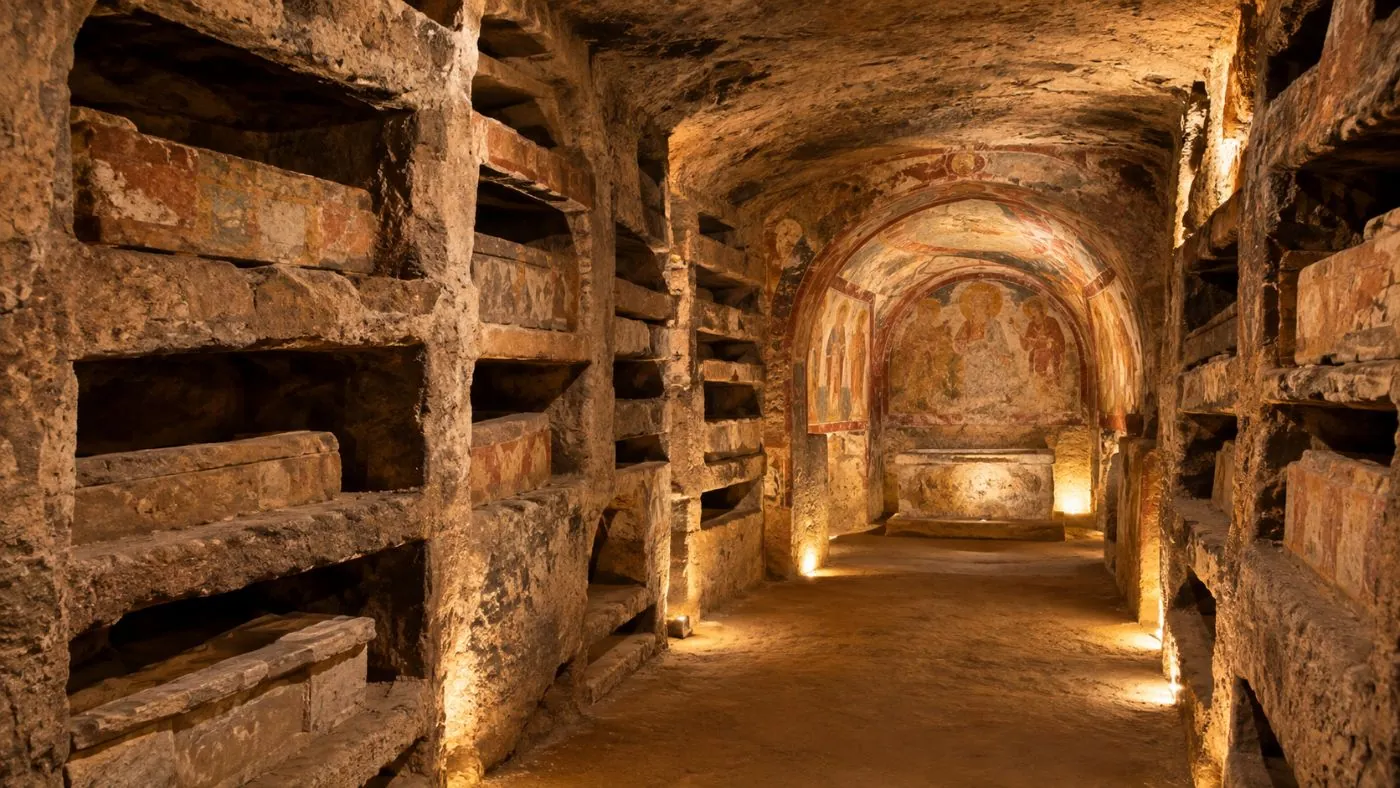
The difference is in the visits. Simply walking is relatively quick, but along the way you’ll encounter catacombs, mausoleums and villas that take time: a guided tour of San Callisto lasts about 40 minutes, and Cecilia Metella or Villa dei Quintili each deserve an hour if you go inside. If you want to see everything at a leisurely pace, plan for a full day.
Also consider the return: the Appian Way is not a loop, and after 9 km you’ll find yourself far from the starting point. Plan in advance where to finish and which bus to take back.
Want to experience the entire Appian Way, from Santa Maria delle Mole to the Circus Maximus? The guided excursion covers about 17 km in 5.5 hours.
Book thisHow much of the Appian Way remains?
In Rome, a well-preserved stretch of about 10 km remains, with long sections of original Roman basalt paving stones south of Cecilia Metella. The complete road, including the Trajan variant, is protected by UNESCO for over 800 km.
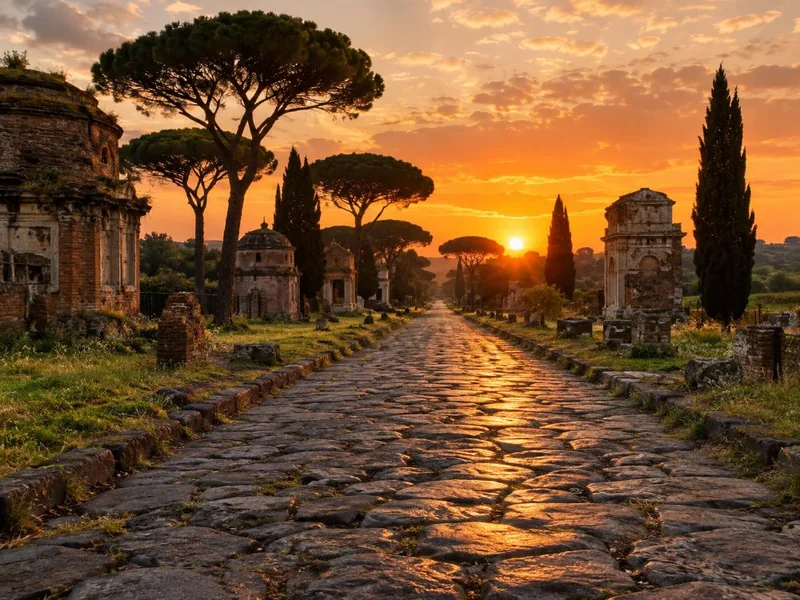
The charm of the Roman Appian Way lies in its continuity: tombs and funerary monuments line both sides of the road, because in ancient Rome burials took place outside the walls. After Cecilia Metella and Capo di Bove the landscape opens up, the paving stones with wheel ruts become the norm and the countryside takes over.
In 2024, the "Via Appia. Regina Viarum" was added to the World Heritage List as the 60th Italian site, with 22 components. For the full history, read our guide to the history of the Appian Way.
What is the most beautiful stretch to walk?
The section south of the Mausoleum of Cecilia Metella: ancient paving stones, tombs on either side and little traffic. The first stretch from Porta San Sebastiano is more interesting for its monuments than for the walk itself.
The table divides the road into sections, so you can choose where to start based on the time and energy you have.
| Section | What you’ll see | Background | For whom |
|---|---|---|---|
| Porta San Sebastiano - Quo Vadis | The gate, the Museum of the Walls, the church of Domine Quo Vadis | Asphalt, with traffic | Those who want to start from the beginning of the road |
| Quo Vadis - Villa di Massenzio | San Callisto and San Sebastiano catacombs, Villa and Circus of Maxentius | Asphalt, with some traffic | Those who combine the walk with a catacomb |
| Cecilia Metella - Capo di Bove | Mausoleum of Cecilia Metella, Castrum Caetani, Capo di Bove | Roman basalt paving stones and asphalt | Those starting with bus 660 |
| South of Capo di Bove | Roman basalt paving stones with wheel ruts, tombs, pines, countryside | Irregular Roman basalt paving stones | Those seeking the most evocative Appian Way |
| Towards Villa dei Quintili | Remains of the villa of the Quintili brothers | Long stretches of Roman basalt paving stones | Walkers with half a day or more |
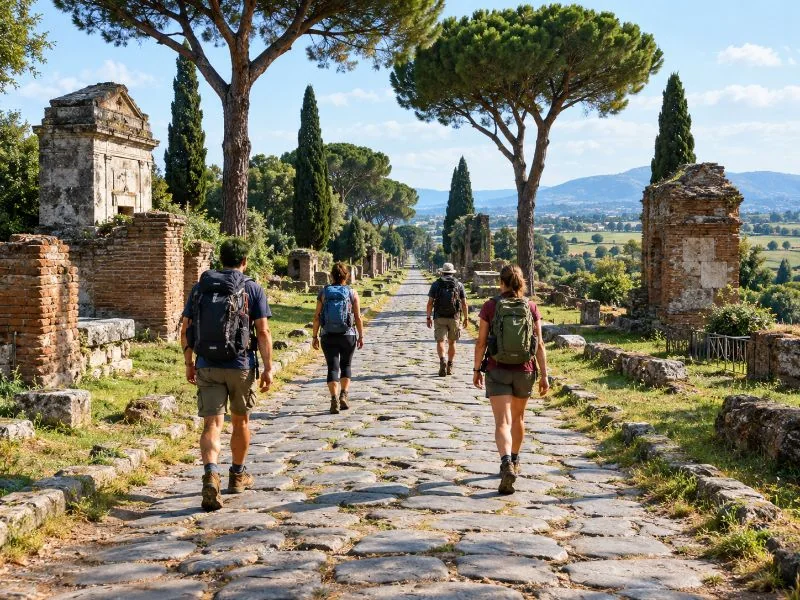
About 17 km along the Appian Way with a hiking guide, through countryside, ancient villas and nature, up to the Circus Maximus.
Book thisWhat issues are there with traffic?
In the first stretch, cars drive and the sidewalks are not designed for pedestrians. From 19 September 2026, a limited traffic zone with electronic gates is being tested on Saturdays and Sundays, from 7 am to 7 pm.
The experimental limited traffic zone covers Via Appia Antica between Via delle Mura Latine and Via Appia Pignatelli, and Via Ardeatina from Via delle Sette Chiese to the Appian Way. It is active every Saturday and Sunday from 7 am to 7 pm, all year round except August, and started with a 30-day pre-operative phase. Public transport, bikes, tourist buses, residents, people with disabilities, workers and emergency vehicles are still allowed.
In practice, on weekends the first stretch should be quieter than on weekdays. On weekdays, walk in a line on the side of the road and be careful on the curves.
What to bring for walking on the Appian Way?
Shoes with thick soles, water, sun protection and something to eat. On the Roman basalt paving stones, thin shoes are uncomfortable right away, and in the most beautiful stretches there is little shade.
An essential list:
- Shoes: light hiking or sturdy gym shoes. The Roman basalt paving stones are uneven and have wheel ruts; sandals are a bad idea.
- Water: bring plenty, especially from May to September.
- Sun protection: hat and sunscreen, as the pines only provide partial shade.
- ID and payment card: useful for tickets to paid sites.
- Covering clothing if you plan to enter a catacomb: shoulders and knees must be covered, as indicated in the offers.
If you prefer to cover more ground without getting tired, consider a bike: here are the e-bike and rental options.
How do you return to the city center after the walk?
By bus 118, which runs along the Appian Way towards the Circus Maximus and Piramide area, or by bus 660, which from Cecilia Metella takes you to metro A Colli Albani.
Decide on your endpoint before you start. If you end your walk near Cecilia Metella, the 660 is the most convenient way to reach the metro. If you head back towards the catacombs, the 118 takes you back towards the centre.
Those who want to walk the entire Appian Way without worrying about transport can choose theguided walking tour on the Appian Way: depending on the offer, it starts from the platform at Santa Maria delle Mole station, about 20 minutes by train from Termini, and arrives at the Circus Maximus after roughly 17 km and 160 m of elevation gain. It is rated as challenging, takes place in any weather and is conducted in English and German. Transport, food and entry fees are not included.
Explore all of the Roman Appian Way in a day, with a guide telling stories of history and nature: walk from the countryside all the way to the Circus Maximus.
Book thisFrequently asked questions
Is walking on the Appian Way free?
Yes. The road and the open sections of the park can be walked for free. You only pay for some monuments, such as Cecilia Metella, Capo di Bove and Villa dei Quintili, and the catacombs.
How many kilometres do you walk on the Appian Way?
A classic walk is about 9 km, taking 4-6 hours with stops. In Rome, the well-preserved stretch is about 10 km.
Is the Appian Way closed to cars?
Only partially. From 19 September 2026, a limited traffic zone is being trialled on Saturdays and Sundays from 7 am to 7 pm, except in August, on the first stretch of the road. On weekdays, cars can drive.
Can you walk the Appian Way with children?
Yes, by choosing a short, traffic-free stretch, for example south of Cecilia Metella. For very young children the Roman basalt paving stones are tiring, so a sturdy stroller or a baby carrier is better.
Ready to book
Choose your tour
Bookable on GetYourGuide, with free cancellation up to 24 hours before.
17 km trekking along the Appian Way
About 17 km on foot from Santa Maria delle Mole to the Circus Maximus, through countryside, villas and silence; challenging, hiking shoes required
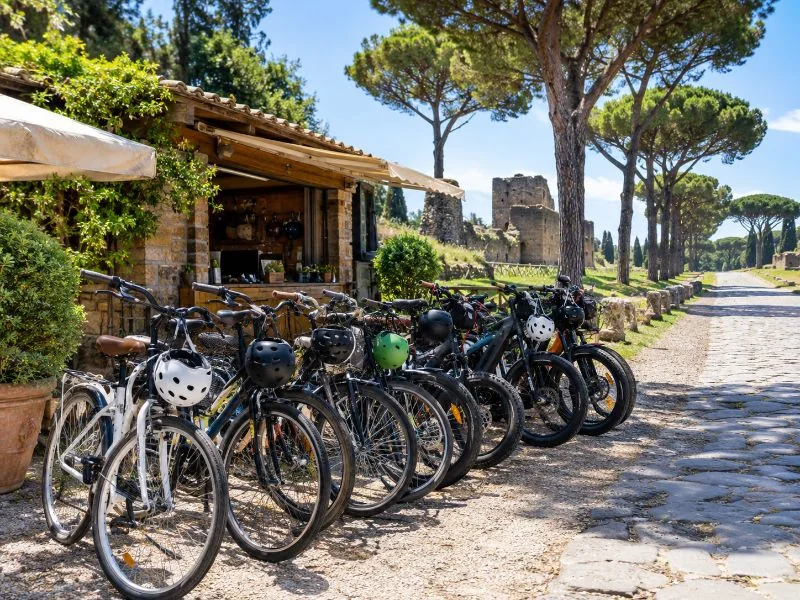
Bike rental for a day on the Appian Way
Bike, helmet and lock at the rental point on the Appian Way; you choose the itinerary, among catacombs, villas and tombs
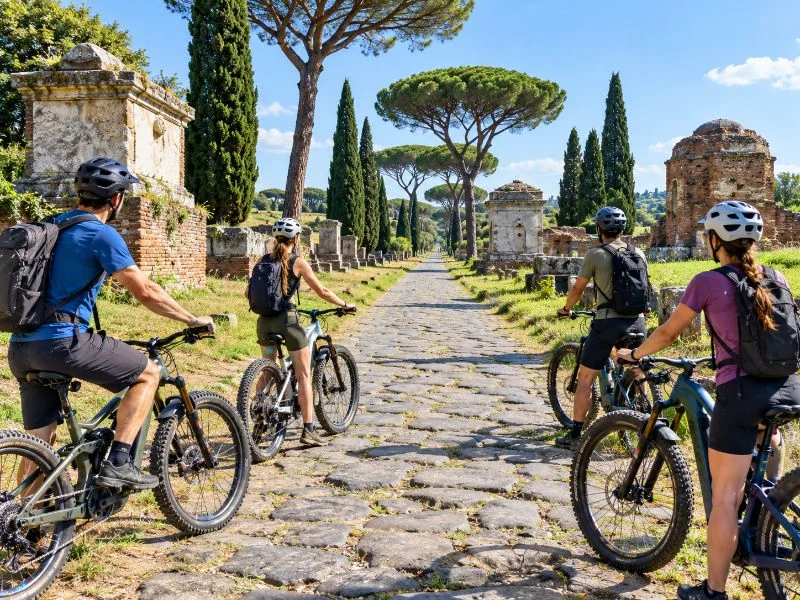
Appian Way and Aqueducts by e-bike
- Full-suspension electric e-bike, suitable for the uneven surface of the Roman basalt paving stones
- Multilingual guide: Italian, English, French or Spanish
- Villa of Maxentius and Mausoleum of Cecilia Metella along the route, then the Parco degli Acquedotti